Not every painting contractor delivers what they promise. Here are five warning signs Suffolk County homeowners should know before hiring anyone.

Most homeowners don’t realize something went wrong until it’s too late — the paint is peeling, the contractor has stopped returning calls, or the final invoice is nothing like the original quote. Finding a reliable interior painting contractor in Suffolk County isn’t difficult if you know what to look for. The problem is that most people don’t know what to look for until they’ve already had a bad experience. This guide is designed to change that.
Here are five red flags that should give you pause before you hire anyone to touch your walls — and what a legitimate contractor looks like by comparison.
Before you evaluate a single quote, you need to ask a few basic questions — and pay close attention to how the contractor responds. Not just what they say, but how quickly they say it and whether they seem comfortable answering.
Ask for their Suffolk County Home Improvement Contractor license number. Ask whether their crew are direct employees or subcontractors. Ask what paint brands they use and why. Ask how they handle prep work before any paint goes on. These aren’t trick questions — they’re standard, and any contractor who’s been doing this legitimately for any length of time should answer them without hesitation.
If you get vague answers, deflection, or a sudden pivot to talking about price, that’s information. A contractor who can’t explain their process clearly before the job starts won’t communicate any better once it’s underway.
This is the red flag most homeowners don’t know to look for — and it’s one of the most consequential ones. Suffolk County is one of a small number of counties in New York State that legally requires a Home Improvement Contractor license for anyone performing residential renovation work, including painting. This isn’t a technicality. Under Chapter 563 of the Suffolk County Code, it is explicitly unlawful to operate as a home improvement contractor without that license — and the definition of “home improvement” specifically includes painting residential structures.
Getting that license isn’t automatic. It requires a completed application, proof of identity and business registration, a minimum of $500,000 in general liability insurance, workers’ compensation coverage, and passing a written examination based on the Home Improvement Law and Article 36-A of New York State General Business Law. That exam tests knowledge of consumer protection law, not just painting technique. In other words, a licensed contractor has demonstrated they understand their legal obligations to you as a homeowner.
Why does this matter practically? If an unlicensed contractor damages your property, abandons the job, or does substandard work, your legal options are severely limited. You can’t file a complaint with the Suffolk County Department of Labor, Licensing & Consumer Affairs in Hauppauge if the contractor was never registered with them. Your homeowner’s insurance may not cover damage caused by an unlicensed worker. And if unpermitted or improperly performed work is discovered during a future home sale, it becomes your problem to resolve.
The fix is simple: ask for the license number and verify it. Any legitimate contractor will give it to you without hesitation. We hold Suffolk County Home Improvement Contractor License #HI-71285 — you’re welcome to look it up. If a contractor can’t or won’t provide a verifiable license number, that’s not a minor oversight. It means they’re operating illegally in this county, and you have no protection if things go sideways.
References are the single most reliable pre-hire signal available to you — and they’re almost always underused. Most homeowners either skip the reference check entirely or ask something so general (“Were you happy with the work?”) that the answer tells them nothing useful. The goal of a reference call isn’t to confirm that someone was satisfied. It’s to surface the details that don’t show up in a polished estimate or a five-star review.
Here’s what’s actually worth asking. First, did the final price match the original quote? This one question will tell you more about a contractor’s honesty than almost anything else. If there were cost increases, were they explained clearly and in advance, or did they show up as surprises on the final invoice?
Second, who actually showed up to do the work — was it the same crew throughout the project, or did different people appear at different stages? Third, how did the contractor handle communication once the job was underway? Did they check in regularly, or did the homeowner have to chase them down for updates?
Also ask about prep work specifically. Did the contractor patch walls, sand surfaces, and prime before painting — or did they show up with rollers and go straight to color? This matters enormously for how long the paint job holds up. Long Island’s coastal environment is genuinely harder on paint than most of the country. Salt air from the Atlantic and the Sound accelerates degradation on surfaces that weren’t properly prepared. A paint job done on walls that weren’t correctly primed and patched will start showing wear within months in a home near the water — whether that’s in Bay Shore, Port Jefferson, or anywhere along the South Shore.
Finally, ask the reference whether they would hire the same contractor again for a different project. The answer is almost always more revealing than anything else they’ve said.
Want live answers?
Connect with a Jaguar Renovation expert for fast, friendly support.
Even if the reference checks out and the license is verified, there are still questions worth asking before you sign anything. A lot of the problems homeowners run into — hidden fees, mid-project disappearances, subpar materials — are preventable if you ask the right things upfront and get the answers in writing.
The most important of these is payment structure. Industry standard for a painting project is somewhere between 25% and 50% upfront, with the remainder due on completion. Any contractor who asks for full payment before the work begins is a red flag — not because they’re necessarily dishonest, but because it removes your leverage entirely if something goes wrong. A contractor who needs 100% upfront before lifting a brush has a cash flow problem, not a trust problem with you personally.
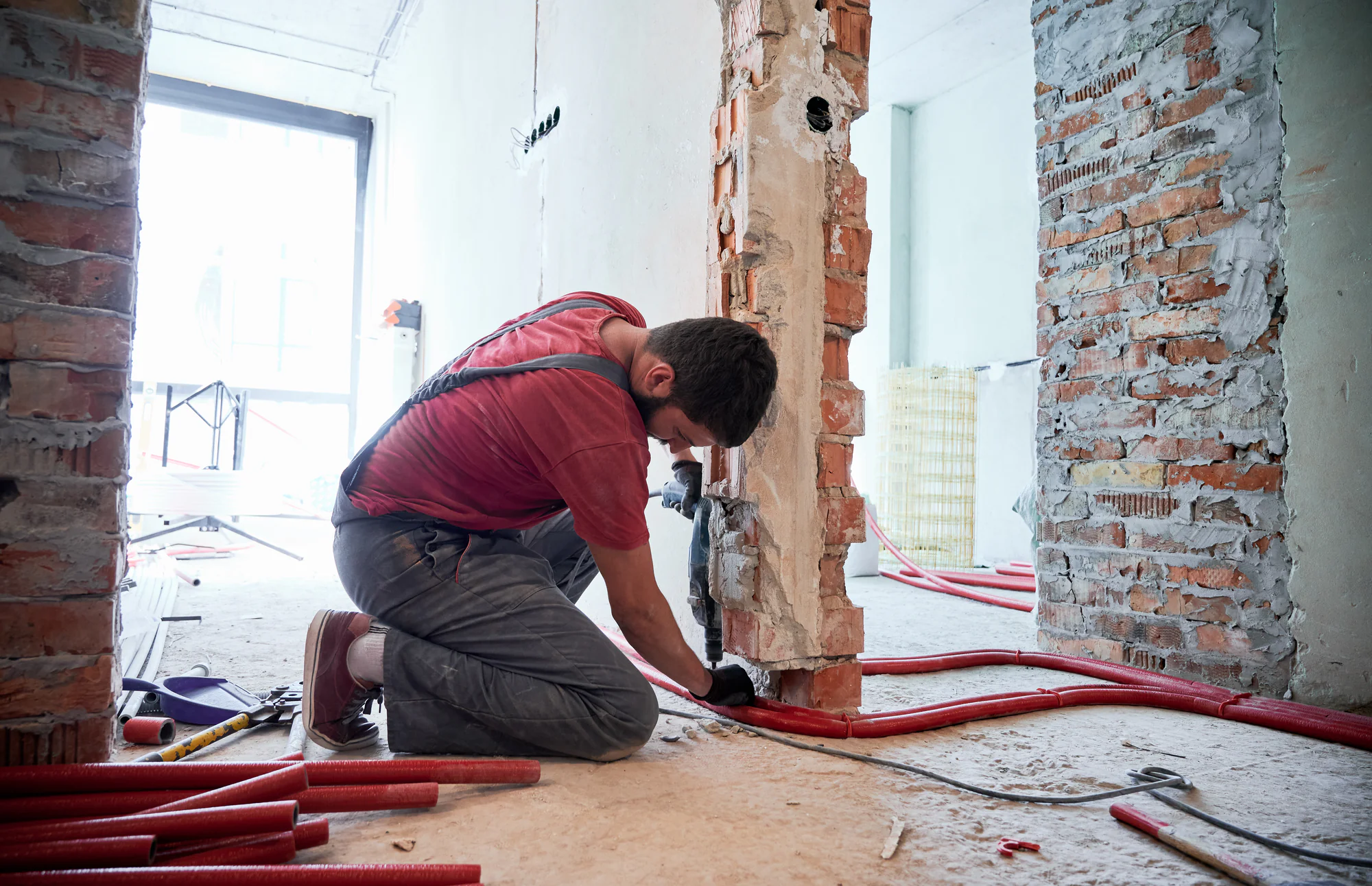
Payment red flags don’t always look dramatic. Sometimes it’s a contractor who asks for a large cash deposit with no written receipt. Sometimes it’s a quote that’s significantly lower than every other estimate you received — not because they’re more efficient, but because they’ve priced out the insurance, the quality materials, or the prep work. Sometimes it’s a request to pay everything upfront “to lock in your spot” before a written contract has been signed.
The rule of thumb from licensed contractors in the industry is that asking for more than 10 to 15 percent upfront — outside of jobs with unusually heavy material costs — is often a signal of cash flow issues. That’s not a healthy business practice, and it puts you at risk. A contractor who can’t fund the beginning of your project without your deposit money may not be able to complete it either.
What a healthy payment structure looks like in practice: a clear written contract that specifies the scope of work, the materials to be used (including paint brand and grade), the timeline, the crew composition, and the payment schedule. The contract should also include a written warranty on labor. If the contractor hesitates to put any of these things in writing, that hesitation is the answer to your question about whether to hire them.
We give every client a detailed written estimate within 48 hours and a fixed price that doesn’t change — because the quote we give is the price you pay. No surprises on the back end, and no pressure to sign before you’ve had time to compare your options.
Here’s a scenario that plays out more often than most homeowners realize. You meet a professional, well-presented contractor for your estimate. The conversation goes well. You sign a contract. Then on the first day of the project, a crew of people you’ve never met shows up at your door — and the contractor you hired isn’t among them.
This is the subcontractor model, and it’s more common than the industry likes to admit. Many contractors who present themselves as established businesses are essentially lead generators — they win the job, then hand it off to rotating crews whose skill levels, insurance status, and commitment to quality standards can vary significantly. The homeowner has no relationship with the people actually in their home, and the contractor has limited accountability over how the work gets done.
This matters for a few reasons. First, subcontractors may not carry the same insurance as the contractor you hired — which means if someone is injured in your home, the coverage picture gets complicated fast. Second, subcontractors have no stake in your satisfaction beyond the immediate job. They’re not building a long-term reputation in your community; they’re moving to the next site. Third, quality control is genuinely harder when the people doing the work aren’t direct employees who’ve been trained to a consistent standard.
In Suffolk County’s tighter residential communities — from Huntington to Smithtown, Brentwood to Patchogue — word travels. Homeowners talk to their neighbors, check local Facebook groups, and ask around before hiring. That community accountability is part of why contractors who rely on rotating subcontractors tend not to build lasting reputations here.
We use in-house crews only. The people who show up on day one are the same people who finish the job, and they’re accountable to us and to you throughout the entire project.
The five red flags covered here — unlicensed operation, vague or verbal-only agreements, predatory payment demands, unvetted subcontractors, and skipped prep work — aren’t rare exceptions. They’re common enough that nearly every homeowner in Suffolk County either knows someone who’s been burned or has experienced it themselves.
The good news is that none of them are hard to screen for if you know what to ask. Verify the license. Get everything in writing. Ask for references and actually call them. Find out who’s going to be in your home. And pay attention to how a contractor communicates before the job starts — because that’s a preview of how they’ll communicate once it’s underway.
If you’re planning an interior painting project anywhere in Suffolk County and want a straightforward conversation about what the job involves, what it will cost, and what to expect from start to finish, Jaguar Renovation is ready to help. Excellence built in, extra cost left out.
Summary:
Article details:
Share: