Before you hire anyone or sign anything, there are a few things every Suffolk County homeowner should know about starting a renovation the right way.
You’ve decided it’s time. Maybe the kitchen hasn’t been touched since the ’80s, the bathroom grout is beyond saving, or the basement is just wasted space. Whatever the project, the instinct is usually the same: get a few quotes, pick someone, and get started.
That instinct skips a few steps that matter. A lot of renovation projects in Suffolk County go over budget, run long, or end with a homeowner wishing they’d asked more questions upfront. Not because renovation is inherently chaotic — but because most people don’t know what to look for before they hand over a deposit. Here’s what you should know before any of that happens.
The first thing most homeowners do is search online, ask a neighbor, or check a review platform. That’s a reasonable start. But reviews only tell part of the story, and a polished website tells even less.
What actually separates a reliable contractor from a risky one comes down to a few specific, checkable things — not gut feel, not how professional the estimate looks, and not how many five-star reviews they’ve collected. Before you commit to anyone, there are two things you should verify directly.

Here’s something most homeowners don’t realize: New York State does not issue a statewide general contractor license. There’s no single credential you can look up to confirm a contractor is legally authorized to work across the state. Licensing in New York is handled at the county level — and that distinction has real legal weight.
In Suffolk County, home improvement contractors are licensed through the Suffolk County Department of Labor, Licensing & Consumer Affairs. To hold that license, a contractor must carry a minimum of $500,000 in combined liability insurance and workers’ compensation coverage. They have to pass a written exam. They have to submit documentation. It’s not automatic, and it’s not cosmetic.
Why does this matter to you? Because if a contractor isn’t properly licensed under Suffolk County’s home improvement licensing rules, they generally cannot enforce a contract against you in court — but more importantly, you also lose legal protections you’d otherwise have. Courts have held that unlicensed contractors are barred from recovering payment and from enforcing liens. That sounds like it protects you, but the real risk is subtler: unlicensed work creates liability that follows the homeowner, not the contractor.
Before you sign anything, ask for the contractor’s Suffolk County HIC license number and verify it yourself at suffolkcountyny.gov. A legitimate contractor will give you that number without hesitation. Our license is HI-71285 — you’re welcome to look it up.
Insurance is the other half of this. If a worker is injured on your property and the contractor doesn’t carry workers’ compensation, the claim can come back to you as the homeowner. It’s not a hypothetical — it happens. Confirming both the license and the insurance certificate before work begins is one of the simplest, most protective things you can do.
A lot of Suffolk County homeowners hire a contractor based on a sales consultation — a polished presentation, a thorough walkthrough, a detailed proposal — and then discover that the people who actually show up to do the work are subcontractors they’ve never met.
This isn’t automatically a problem, but it creates accountability gaps that are worth understanding. When a general contractor subs out the work, the people in your home are working for someone else. If a scheduling conflict comes up, their primary obligation is to the subcontractor who hired them, not to your project. If something is done incorrectly, the conversation about who’s responsible gets complicated fast.
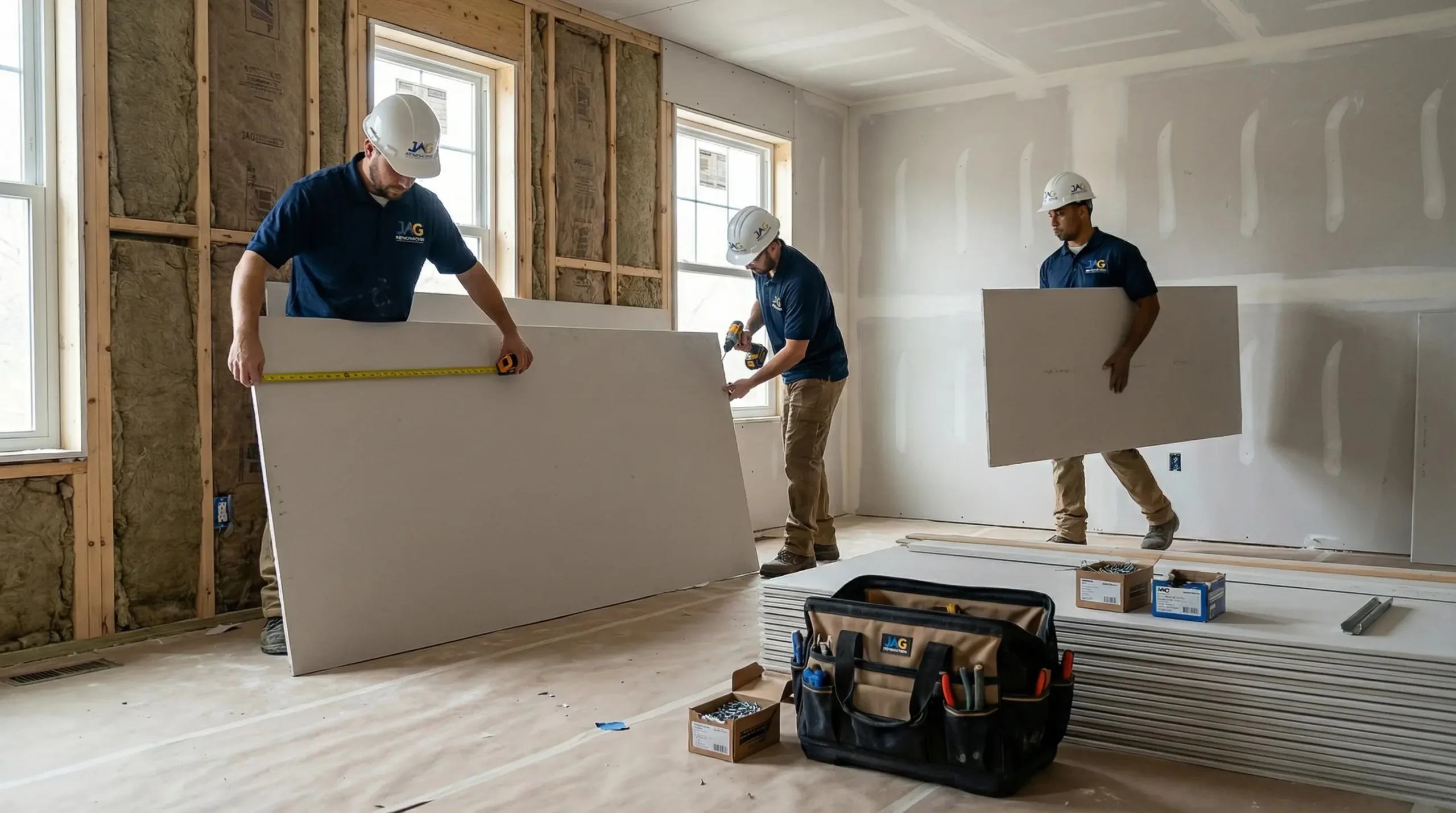
With an in-house crew, the chain of accountability is short. The people doing the work are employed by the company you hired. They’re trained the same way, held to the same standards, and show up on the schedule we committed to — not whenever a subcontractor happens to be available.
We only use in-house crews. That’s not a marketing line — it’s a structural decision that affects your project’s timeline, consistency, and who you can actually hold accountable if something needs to be addressed. Before you hire anyone, ask them directly: “Will your own employees be doing the work, or will you subcontract it?” The answer will tell you a lot about how the project will actually run.
For homeowners in Smithtown, Setauket, Huntington, and throughout Suffolk County — where older housing stock means projects often surface unexpected conditions inside walls — having a consistent, experienced crew on-site every day isn’t a luxury. It’s how projects stay on track when things get complicated.
Want live answers?
Connect with a Jaguar Renovation expert for fast, friendly support.
The most expensive mistake Suffolk County homeowners make in a renovation isn’t choosing the wrong tile or splurging on an upgrade. It’s choosing the lowest bid.
Seventy-eight percent of home improvement projects go over budget nationally — and nearly two-thirds of homeowners end up taking on debt to cover costs they didn’t expect. Most of that isn’t bad luck. It’s the predictable result of a low-ball estimate followed by a steady stream of change orders once the work is underway.
Understanding what things actually cost in this market, before you’re sitting across from a contractor, is the best protection you have.

Renovation costs on Long Island run higher than national averages, and Suffolk County is no exception. The combination of labor costs, permit requirements, and the region’s coastal construction demands all push numbers up compared to what you might read in a general home improvement guide.
For a bathroom remodel, expect to spend somewhere in the range of $16,500 to $36,000 for a standard to mid-grade project. Basic small bathroom work can start around $15,000; mid-grade projects typically fall between $21,000 and $40,000; high-end renovations exceed $40,000. For kitchens, budget-level updates — keeping the existing layout and using stock materials — generally come in around $20,000 to $25,000, while mid-grade remodels start closer to $30,000. Basement renovations in Suffolk County start around $35,000 for basic projects and climb to $60,000 or more for mid-range upgrades with full finishes.
Across all project types, labor typically represents 40% to 60% of total cost. For a $20,000 remodel, you’re looking at $8,000 to $12,000 in labor alone. That number doesn’t shrink just because a contractor quotes you a lower total — it just means something else is being cut, or the shortfall is being recovered later through change orders.
Suffolk County permit fees typically run between $300 and $1,000 depending on scope, and most bathroom, kitchen, and basement projects require permits for plumbing, electrical, or structural work. Unpermitted work is the homeowner’s liability — not the contractor’s. If you sell your home and the work wasn’t permitted, it can delay or derail the sale. Make sure permit management is part of whatever agreement you sign.
The best time to book a renovation in Suffolk County is spring or fall. Summer demand surges, which means longer waits and less contractor availability. If you’re flexible on timing, booking outside peak season often means a faster start date and more attention to your project.
A detailed written estimate is the single most important document in any renovation project. Not because it’s legally binding on its own — but because how a contractor writes an estimate tells you almost everything about how they’ll handle your project.
A legitimate estimate breaks down labor, materials, and scope in enough detail that you can actually understand what you’re paying for. It specifies what’s included and what isn’t. It gives you a timeline with a start date and a projected completion date. It doesn’t leave room for interpretation on the things that matter most.
A low-ball estimate does the opposite. It gives you a number that’s hard to argue with, wins the job, and then recovers the margin through change orders — charges for “unforeseen conditions,” scope additions, or items that were vaguely worded in the original agreement. This is a documented pattern across the industry. Most contractors give a low estimate to win the job, then hit you with changes once the work starts.
The alternative is a fixed-price contract: the number you’re quoted is the number you pay, unless you decide to change something mid-project. That kind of pricing requires a contractor to do their homework upfront — to walk the space thoroughly, ask the right questions, and build a scope that accounts for what’s actually there. It’s more work for the contractor before the job starts, but it’s the only structure that genuinely protects you.
A few other things worth looking for in any estimate: a written workmanship warranty, a clear payment schedule (a down payment of around 15% is typical — be cautious of anyone asking for the full amount upfront), and confirmation that the contractor will pull permits for all required work. If any of those are missing, ask why before you sign.
Long Island’s housing stock — much of it built between the 1950s and 1980s in towns like Bay Shore, North Babylon, Coram, and Patchogue — means older homes regularly surface surprises once work begins. A contractor who’s done this work in Suffolk County for years knows what to expect inside those walls. That experience should be reflected in how we write the estimate, not used as an excuse to add charges after the fact.
The homeowners who end up happiest with their renovations aren’t necessarily the ones who spent the most or found the cheapest bid. They’re the ones who asked the right questions before the work started — verified the license, understood the real costs, confirmed who would actually be doing the work, and got everything in writing.
None of that is complicated. It just requires knowing what to look for before you’re in the middle of a project with no easy exit.
If you’re planning a kitchen, bathroom, basement, or any other interior renovation in Suffolk County and want to talk through the project with a contractor who will give you straight answers — no pressure, no vague estimates, no surprises — Jaguar Renovation is ready to help.
Summary:

Article details:
Share: