
Hear from Our Customers
You’re not looking for the cheapest flooring contractor in Melville. You’re looking for someone who shows up, does what they said they’d do, and leaves you with floors that hold up to real life.
That means hardwood that doesn’t buckle after the first humid summer. Vinyl plank that actually looks like wood and doesn’t peel at the seams. Tile work where the grout lines are straight and the edges don’t crack in six months. The kind of work that makes you glad you didn’t go with the guy who quoted half the price and disappeared halfway through.
When the project’s done, your floors should feel solid underfoot. The transitions should be clean. The finish should be even. And when someone asks who did the work, you shouldn’t hesitate to give them the name.
That’s what nearly ten years in Suffolk County teaches you. Not just how to install flooring, but how to do it in a way that doesn’t create more problems than it solves.
We handle residential and commercial flooring projects across Melville and Suffolk County. We’re not a national franchise or a crew that bounces between states. We’re local, licensed, and we’ve been installing floors in homes just like yours for close to a decade.
Most of our work comes from referrals. That happens when you communicate clearly, show up on time, and don’t tack on surprise costs after the estimate. It also happens when the floors you install don’t need fixing a year later.
Melville homeowners deal with humidity swings, older home foundations, and the reality of Suffolk County’s housing stock. We account for that during prep. We don’t skip steps to save time, and we don’t sell you materials that won’t hold up in this climate. If your subfloor needs work, we tell you before we start, not after we’ve already torn up the old flooring.

First, we come out to look at the space. We measure, check the subfloor, talk through what you’re hoping to accomplish, and answer questions about materials. You’ll get a written estimate that breaks down labor, materials, and prep work. No vague line items.
Once you’re ready to move forward, we schedule the work and give you a realistic timeline. That includes removal of your existing flooring if needed, subfloor prep, and installation. We also let you know what to expect during the job—noise, dust, how long rooms will be inaccessible.
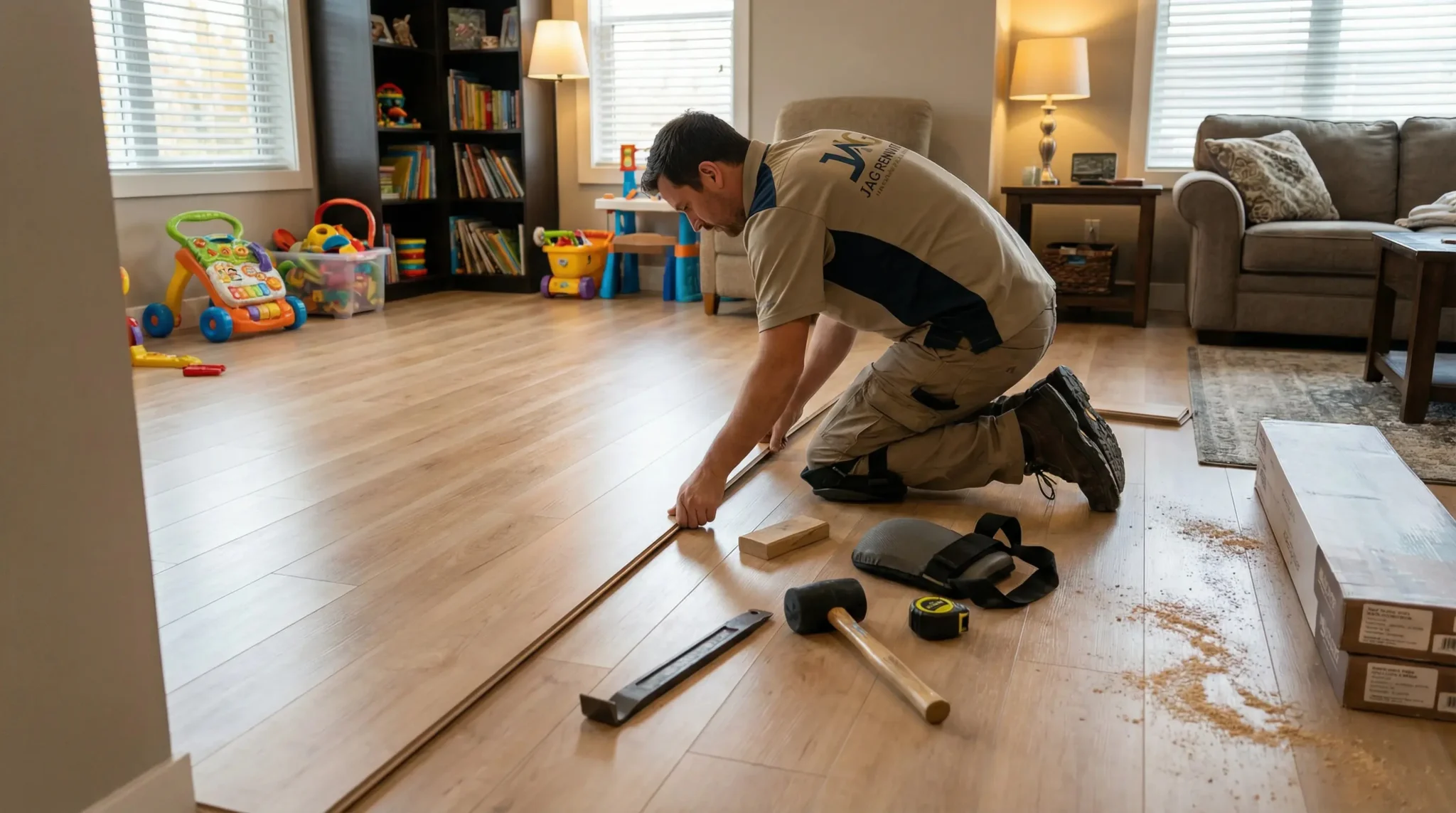
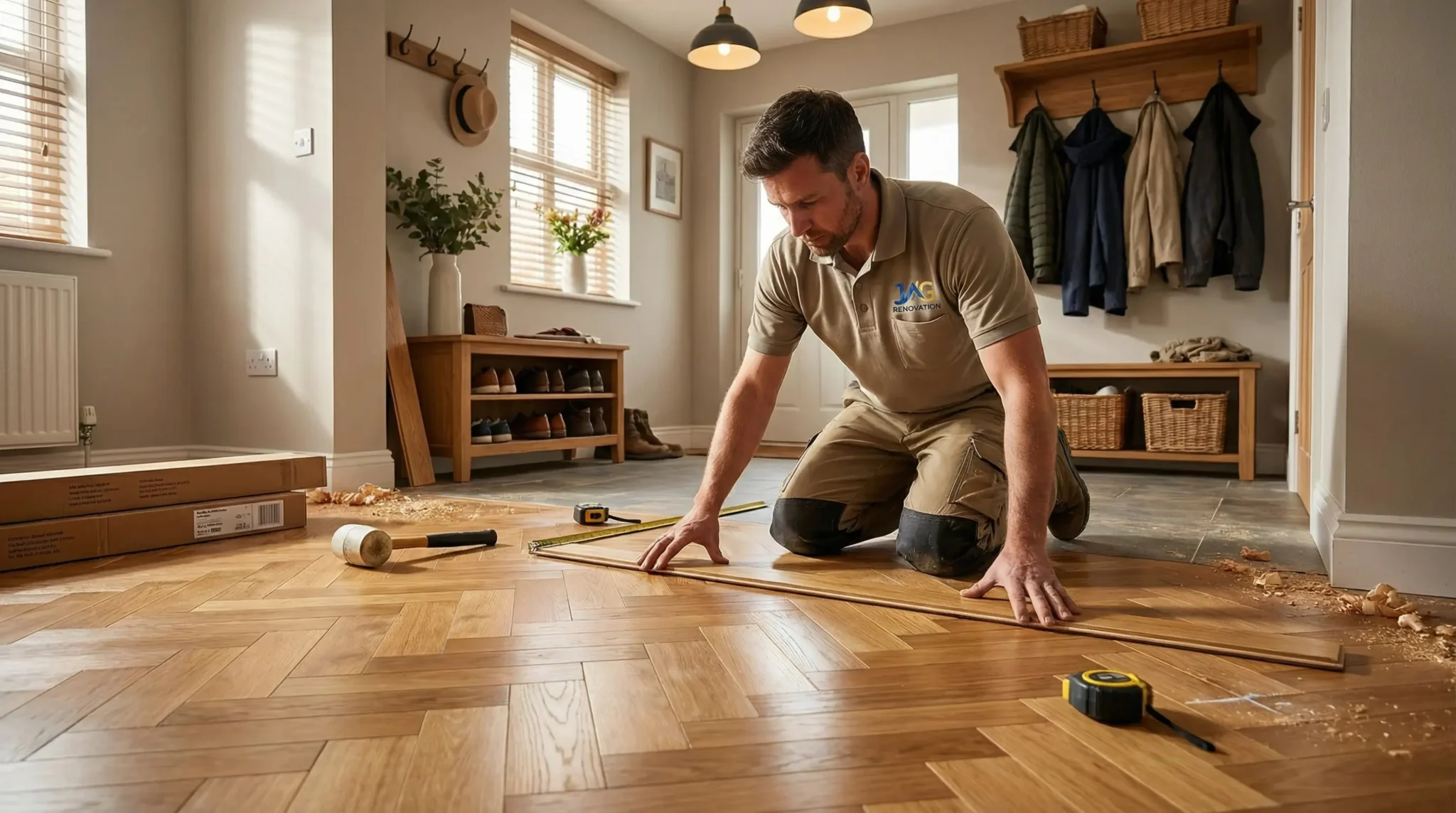
During installation, we handle the details that separate clean work from sloppy work. Underlayment goes down right. Seams get staggered properly. Transitions between rooms and materials get finished so they don’t catch on socks or look like an afterthought.
After installation, we walk the job with you. If something’s not right, we handle it before we pack up. Then we clean up, haul away the old materials, and leave you with floors that are ready to use. No debris in the driveway, no half-finished edges, no “we’ll come back next week to finish that.”

Ready to get started?
We install hardwood, engineered hardwood, luxury vinyl plank, laminate, ceramic tile, and porcelain tile. Each material has trade-offs, and we’ll tell you what those are based on your space, your budget, and how much wear the floor will see.
Hardwood still offers the best return on investment if you’re planning to sell. In Suffolk County, updated flooring can return up to 70% of the cost when you list your home. But hardwood also requires more maintenance and doesn’t love moisture. If you’ve got kids, pets, or a kitchen that sees heavy use, luxury vinyl plank gives you the look of wood with better durability and water resistance.
Tile works well in bathrooms, entryways, and mudrooms—places where water and dirt are constant. Porcelain holds up better than ceramic in high-traffic areas, and the grout quality matters as much as the tile itself. We use proper waterproofing and don’t cut corners on underlayment.
Laminate is the most budget-friendly option, and the quality has improved significantly in recent years. It’s not as durable as vinyl or hardwood, but it’s a solid choice for bedrooms, offices, and spaces that don’t get beaten up daily. The key is proper acclimation and a quality underlayment to prevent that hollow sound cheap laminate is known for.

For a standard room—say, a living room or bedroom around 200-300 square feet—you’re looking at one to two days for installation. That includes removing the old flooring, prepping the subfloor, and installing the new material.
Larger projects take longer. A whole first floor might take four to six days depending on the layout, the number of transitions, and whether we’re dealing with stairs. Tile takes longer than vinyl or laminate because of setting time and grouting.
The prep work is what most homeowners underestimate. If your subfloor isn’t level or has damage, that adds time. Same with removal—old tile or glued-down flooring takes longer to pull up than snap-together laminate. We account for this in the timeline we give you upfront, so you’re not caught off guard when the project takes an extra day.
Luxury vinyl plank is waterproof. Laminate is not. That’s the biggest difference and the reason vinyl has become the go-to choice for kitchens, bathrooms, and basements.
Vinyl is made from PVC and has a printed image layer that mimics wood or stone. It’s softer underfoot than laminate, more resistant to scratches, and it won’t swell if water sits on it. The quality varies widely—cheap vinyl looks cheap and dents easily. Higher-end vinyl with a thicker wear layer holds up better and looks more realistic.
Laminate is made from compressed wood fibers with a photographic layer on top. It’s harder than vinyl, which means it feels more like real wood when you walk on it. But moisture is its enemy. Spills need to be wiped up quickly, and it’s not a good choice for areas prone to water exposure. Laminate also tends to be louder underfoot unless you use a good underlayment.
Both are DIY-friendly if installed correctly, but most homeowners don’t account for subfloor prep, acclimation time, or how to handle tricky cuts around doorways and transitions. That’s where hiring a flooring contractor makes sense.
Yes. We need the rooms completely clear before we start. That means furniture, rugs, floor lamps, and anything else that’s sitting on the floor.
Some flooring contractors offer furniture moving as an add-on service, but it’s usually not included in the base price. We can move smaller items if needed, but large furniture—dressers, beds, couches—should be moved ahead of time or we can coordinate with a moving service if that’s easier for you.
The reason we need everything out is simple: we can’t prep the subfloor, install underlayment, or lay flooring around furniture. Even if we could, you’d end up with seams and cuts in awkward places that look bad and create weak points in the installation. Clear rooms also mean we can work faster and cleaner, which keeps the project on schedule.
For a single room, you’re typically looking at $1,500 to $4,000 depending on the material and the size of the space. Vinyl plank runs around $3 to $7 per square foot installed. Hardwood is closer to $8 to $15 per square foot. Tile falls somewhere in between, depending on the type and the complexity of the layout.
Whole-house projects vary widely based on square footage and what you’re installing. A 1,500-square-foot home might run $7,500 to $20,000 for flooring, but that number moves up or down depending on material choice, subfloor condition, and how much demo is required.
The hidden costs are usually in the prep. If your subfloor is uneven, damaged, or needs moisture mitigation, that adds to the price. Same with removing old flooring—tile and glued-down materials take longer to pull up than floating floors. We include all of this in the estimate so there are no surprises when the bill comes. Suffolk County permit fees are relatively affordable for renovations under $50,000, so that’s not usually a major cost driver for flooring projects.
Porcelain tile and luxury vinyl plank are your best bets for high-traffic areas. Both handle heavy use without showing wear quickly, and they’re easy to clean.
Porcelain tile is harder and denser than ceramic, which makes it more resistant to chips and cracks. It works well in entryways, hallways, and mudrooms—places where dirt, moisture, and foot traffic are constant. The grout is the weak point, so we use high-quality grout and seal it properly to prevent staining and cracking.
Luxury vinyl plank with a thick wear layer holds up nearly as well as tile and feels warmer underfoot. It’s a good choice for kitchens, living rooms, and anywhere you want the look of hardwood without the maintenance. The key is choosing a product with a wear layer of at least 12 mil for residential use and 20 mil for commercial spaces.
Hardwood can work in high-traffic areas if you go with a harder species like oak or maple and use a matte or satin finish. Glossy finishes show scratches and scuffs more easily. Engineered hardwood holds up better than solid hardwood in areas with temperature and humidity fluctuations, which is relevant in Suffolk County homes.
It depends on what’s there and what you’re installing. In some cases, you can install over existing flooring. In most cases, you shouldn’t.
Vinyl plank and laminate can sometimes go over old vinyl or linoleum if the surface is smooth, level, and in good condition. But if the old floor is peeling, bubbling, or uneven, it needs to come up. Installing over a bad surface just transfers those problems to the new floor.
You can’t install new flooring over carpet. The padding creates an unstable base, and the new floor will shift, buckle, or develop gaps. Carpet has to come up, and the subfloor needs to be cleaned and checked for damage before new flooring goes down.
Tile is tricky. You can sometimes install new tile over old tile if the existing tile is well-adhered and the floor is level. But if any tiles are loose or cracked, the whole thing needs to be removed. Installing hardwood or vinyl over tile is generally a bad idea because of height transitions and the lack of a proper substrate. We evaluate this during the initial visit and let you know what makes sense for your specific situation.