What does pressure washing actually cost on Long Island, and how do you hire someone you can trust? Here's what Suffolk County homeowners need to know.

You’ve noticed it — the dark streaks on the siding, the green creeping up the north-facing wall, the driveway that hasn’t looked clean since before COVID. It’s not just dirt. In Suffolk County, where salt air rolls in off the Sound and the Atlantic and humidity lingers well into fall, that stuff growing on your house is alive. And it’s doing damage.
We’ve cleaned hundreds of Long Island homes, and the pattern is always the same: homeowners wait too long, the contamination gets worse, and the job becomes more expensive than it needed to be. This guide covers what pressure washing actually costs on Long Island, when professional help is worth it, what can go wrong if it’s done incorrectly, and — maybe most importantly — what to ask a contractor before you hire one. Let’s start with what’s actually happening to your home’s exterior.
Pressure washing uses high-pressure water to remove dirt, mold, algae, and grime from exterior surfaces — driveways, siding, decks, fences, and more. It sounds straightforward, but the technique matters enormously. Too much pressure on the wrong surface can strip protective coatings from siding, damage deck boards, blow out joint sand in pavers, or force water into wall cavities where it causes far more damage than the algae ever would.
That’s why we don’t just show up with a wand and blast everything at full force. We assess the surface first. Older siding, stucco, and weathered wood typically require soft washing — a low-pressure method that uses biodegradable cleaning solutions to kill organic growth at the root rather than just blasting the visible stain off the surface.
The distinction matters. A contractor who doesn’t ask about your siding material before quoting you probably isn’t thinking carefully about your home.
Nationally, the average cost to pressure wash a house runs between $170 and $360, with per-square-foot pricing typically falling between $0.35 and $0.77. For larger homes or more complex jobs — two-story colonials, homes with significant mold accumulation, properties with extensive hardscaping — costs can range from $350 to $1,500 or more. Hourly rates for professional crews generally run $50 to $100 per crew member.
On Long Island, expect to pay at or above the national midpoint. That’s not price gouging — it’s geography. Suffolk County homes face conditions that drive up both the frequency and the difficulty of exterior cleaning. Salt air from the Long Island Sound and the Atlantic deposits microscopic particles on every exterior surface. Those deposits attract moisture. Moisture feeds mold and algae.
In the older neighborhoods along the North Shore — Port Jefferson, Setauket, Northport, Stony Brook — dense tree canopy keeps surfaces shaded and damp for most of the year, which accelerates organic growth significantly faster than you’d see in a newer, more open development. The result is that a Suffolk County home in a shaded, coastal neighborhood may need professional cleaning every one to two years to stay ahead of the deterioration curve — not every three to five years like you might read in a national guide written for the Midwest.
What drives the final price? Surface area is the biggest factor, followed by the type of surface, the degree of contamination, and whether soft washing is required in addition to or instead of standard pressure washing. A driveway cleaning runs less than a full house wash. A roof soft wash is priced differently than a deck cleaning. Get an itemized quote — not a single flat number — so you understand what’s included.
One more thing worth knowing: the cheapest quote is rarely the best deal. An unlicensed operator working without insurance may charge less, but if a worker is injured on your property and there’s no workers’ compensation coverage, you can be held liable. That’s a risk no amount of savings justifies.
This is the question most homeowners don’t know to ask, and it’s one of the clearest ways to tell whether a contractor actually knows what they’re doing.
Pressure washing and power washing are often used interchangeably, but they’re not identical — power washing uses heated water, which can be more effective on certain grease and oil stains. Soft washing is a different method entirely. It uses low pressure combined with cleaning solutions — typically biodegradable surfactants — to kill mold, algae, and mildew at the biological level rather than just removing the surface stain. For roofs, older siding, painted wood, and stucco, soft washing is almost always the right call. High-pressure washing on those surfaces risks voiding manufacturer warranties, removing protective coatings, or physically damaging the material.
Here’s the practical reality for Suffolk County homeowners: the black streaks on your roof and the green patches on your north-facing siding aren’t just dirty — they’re living organisms. Algae, mold, and mildew actively break down the materials they grow on. Pressure washing alone might remove what you can see, but if the cleaning solution doesn’t kill the organism at the root, it grows back faster than it appeared the first time.
We walk every property before quoting, identify which surfaces need which treatment, and explain the reasoning. If someone gives you a price over the phone without asking a single question about your home’s materials or condition, that’s a sign they’re not approaching the job with the care it deserves.
Pricing for soft washing is generally in the same range as standard pressure washing — the difference is in the equipment, the chemistry, and the expertise required to apply it correctly. It’s not a premium add-on. It’s the right tool for the right surface.
Want live answers?
Connect with a Jaguar Renovation expert for fast, friendly support.
There’s something that happens when you start paying attention to the outside of your house. You notice the algae on the siding, the weathered deck, the driveway that’s been gray for years. And once you’re in that mode — really looking at your home — it’s hard to stop at the exterior.
The homeowners who search for pressure washing services are often the same ones who, a few weeks later, are thinking about the kitchen that hasn’t been touched since 2003 or the bathroom that’s been “on the list” for years. That’s not a coincidence. It’s the same mindset: you’re paying attention to your home, thinking about its condition, and starting to take stock of what needs to change.
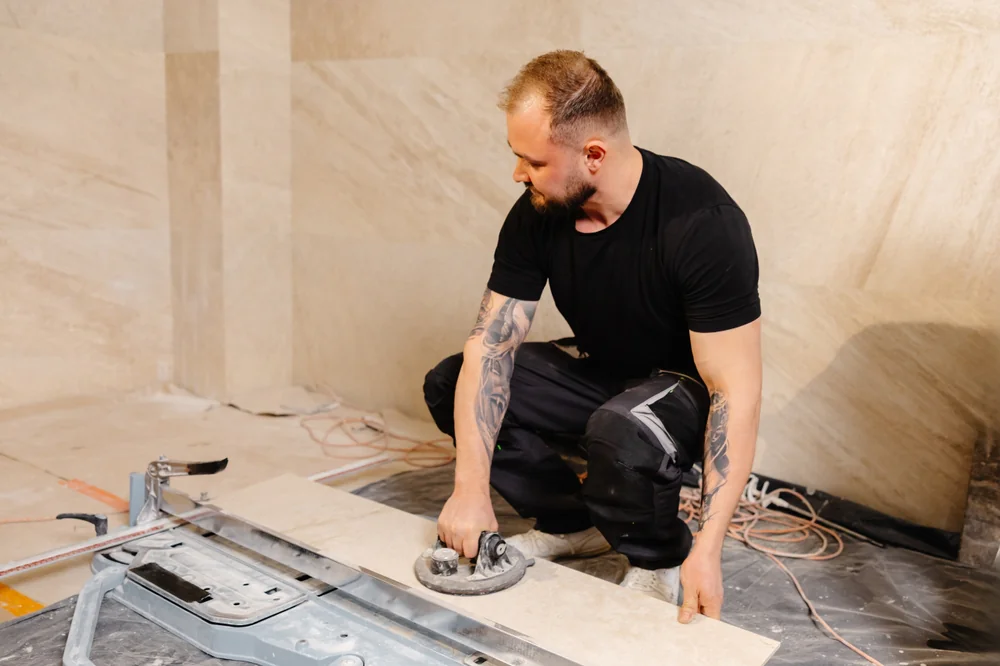
If your pressure washing project is the thing that gets you looking more closely at your home, you’re in good company. A lot of renovation conversations start exactly that way — someone cleans up the outside and suddenly the inside feels overdue.
When that moment comes, the contractor you hire for interior work matters just as much as the one you hire for exterior cleaning — arguably more, because the stakes are higher. Kitchen and bathroom renovations in Suffolk County represent significant investments. According to data specific to this market, kitchen remodels typically range from $15,000 to $50,000, with full renovations running $40,000 to $80,000 or more. Bathroom renovations generally fall between $8,000 and $25,000, with more involved remodels reaching $16,500 to $36,000.
Those are not small numbers. And the horror stories homeowners tell — the contractor who disappeared mid-project, the final bill that bore no resemblance to the quote, the subcontractor who did shoddy work and couldn’t be held accountable — are common enough that most people in Suffolk County know someone it happened to personally.
The things that separate a reliable general contractor from the rest aren’t mysterious. They’re specific and verifiable. A Suffolk County home improvement contractor license (like HI-71285) is searchable in the county’s database. Insurance certificates can be requested before work begins. A written contract with fixed pricing eliminates the “surprise charges” problem at the source. An in-house crew — meaning the people who show up are employees of our company, not third-party subcontractors hired for the job — means there’s a single point of accountability if anything goes wrong.
These aren’t nice-to-haves. They’re the baseline questions you should be asking before anyone sets foot in your home.
Most homeowners don’t feel equipped to interview contractors. They get a few quotes, pick the one that feels right, and hope for the best. That’s understandable — but it leaves a lot to chance in a market where the quality gap between operators is enormous.
Here’s what actually matters when you’re evaluating a contractor for any home improvement work in Suffolk County, NY.
Start with the license. Ask for the contractor’s Suffolk County home improvement contractor license number and look it up. This is a county-specific credential — not a state license, not a general business registration. It means the contractor has met Suffolk County’s specific requirements for financial responsibility, insurance, and competency. Unlicensed operators work in this county regularly, and homeowners who hire them have limited legal recourse when things go wrong.
Ask whether they carry workers’ compensation insurance — and ask for proof, not just a yes. If a worker is injured on your property and the contractor lacks coverage, you can be held personally liable. This is not a hypothetical risk in New York.
Ask who actually does the work. Many contractors sell the job and then hand it off to subcontractors the homeowner has never met and has no relationship with. There’s nothing inherently wrong with subcontracting, but it changes the accountability structure. When the person who sold you the job isn’t the person doing the work, finger-pointing when issues arise becomes a real possibility.
Ask what the contract says about price changes. A fixed-price contract with no hidden fees is a specific, enforceable commitment. A contract that includes language about “unforeseen conditions” or “additional charges as needed” is a contract that can grow after the fact.
Ask about the warranty. A one-year workmanship warranty is a reasonable standard for interior renovation work. If a contractor can’t tell you what they stand behind, that’s worth noting.
Finally, ask how long it will take to get an estimate and when work would start. Vague answers to both questions are common — and they’re a preview of how the contractor communicates throughout the project. A contractor who commits to a detailed estimate within 48 hours and a project start within one to two weeks of approval is telling you something meaningful about how they operate.
These aren’t trick questions. A contractor who’s doing things right should answer all of them easily and without hesitation.
Pressure washing your Long Island home is a smart maintenance move — especially given what salt air, humidity, and four full seasons do to exterior surfaces in Suffolk County. Understanding the cost, knowing the difference between pressure washing and soft washing, and hiring someone who’s actually licensed and insured gets you most of the way there.
But if this is the moment you start paying closer attention to your home — and it often is — the same standards apply to every contractor you bring in. Verify the license. Confirm the insurance. Get a fixed-price contract. Ask who’s actually doing the work.
If you’re thinking about interior renovations alongside your exterior work, Jaguar Renovation serves all of Suffolk County — from Huntington to Patchogue, Smithtown to Bay Shore — with licensed, in-house crews, transparent pricing, and a one-year workmanship warranty on every project. Reach out when you’re ready to talk through what your home needs next.
Summary:
Article details:
Share: